

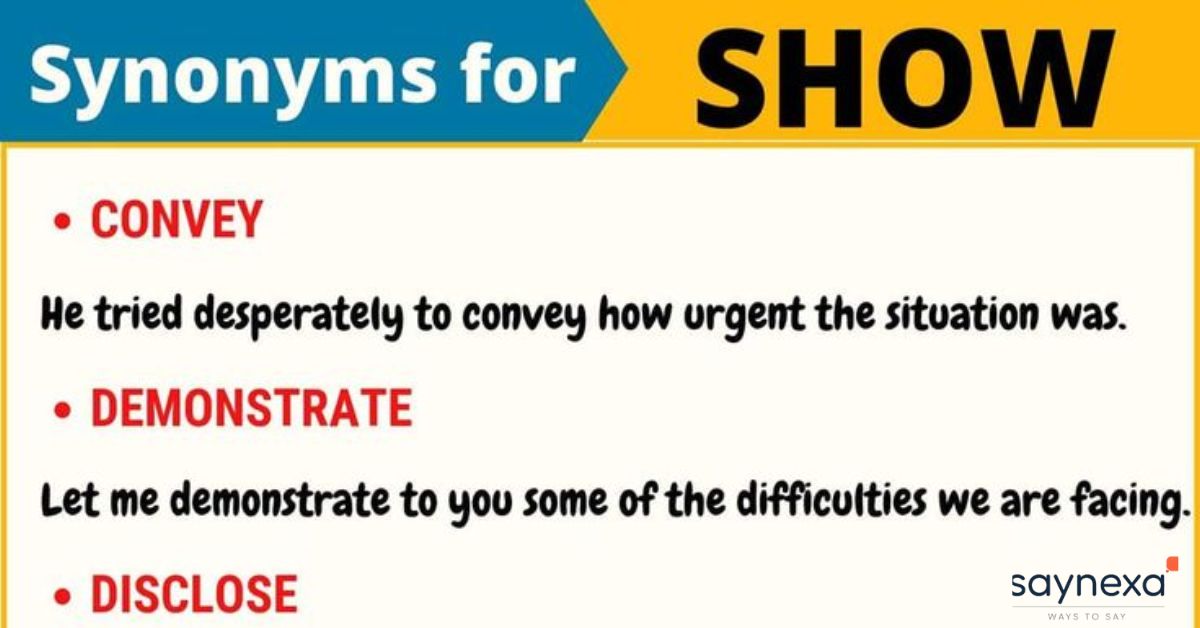
If you use the word “Show Synonyms” too often, your writing or speech can start to sound repetitive. Choosing a different word can make your message clearer, more engaging, and better suited to the situation. Whether you want to describe explaining an idea, displaying something, proving a point, or expressing emotions, there are many useful alternatives to “show.” In this guide, you’ll discover 22 other ways to say “show,” along with simple explanations and examples to help you use each synonym with confidence.
You can also read: 15 Other Ways to Say BETTER | Synonyms for Better (Examples)
22 Different Ways to Say Show (With Examples): Another Word for Show
Display
Display is a useful synonym for “show” when you want to make something clearly visible for others to see. It is often used for objects, artwork, products, awards, or information that is arranged in a noticeable way. The word sounds more formal than “show” and suggests presenting something with care or purpose. You can also use display to describe demonstrating a quality, talent, or emotion. It works well in both everyday conversations and professional writing.
- Display your new art on the wall.
- The museum will display the old crown.
- She likes to display her many trophies.
- Stores display candy near the front door.
- Please display your pass at the gate.
- He will display his skills during practice.
Reveal
Reveal is a great alternative to “show” when you want to make something known that was previously hidden or secret. It is often used for information, emotions, surprises, or discoveries. This word adds a sense of excitement or importance because it suggests that something is being uncovered for the first time. Reveal works well in everyday conversations, storytelling, news, and formal writing.
- She will reveal the surprise after dinner.
- The report revealed important facts.
- He refused to reveal his secret.
- The clouds revealed the bright moon.
- The artist revealed her latest painting.
- The investigation revealed the truth.
Explain
Explain is a helpful alternative to “show” when you want to make something clear by giving details or reasons. It is commonly used when teaching, answering questions, or describing how something works. This word focuses on helping others understand an idea, process, or situation. Explain is suitable for everyday conversations, schoolwork, business, and professional writing.
- Please explain the homework to me.
- She explained the rules before the game.
- The teacher explained the lesson clearly.
- Can you explain how this machine works?
- He explained why he was late.
- The guide explained the history of the building.
Present
Present is a strong alternative to “show” when you want to introduce, display, or share something in a formal or organized way. It is often used for ideas, reports, projects, speeches, and results. The word suggests that something is being shared with an audience in a clear and professional manner. Present works well in business, education, meetings, and formal writing.
- She will present her research tomorrow.
- The team presented their new idea to the manager.
- He presented the award to the winner.
- Students will present their science projects.
- The speaker presented the facts clearly.
- We will present the final report next week.
Demonstrate
Demonstrate is a useful alternative to “show” when you want to prove, illustrate, or teach something through actions or clear evidence. It is often used when explaining how something works, proving a fact, or displaying a skill. This word sounds more formal than “show” and is common in education, business, science, and professional writing. Demonstrate emphasizes making something easy to understand through examples or performance.
- The teacher demonstrated how to solve the problem.
- He demonstrated the new software to the team.
- She demonstrated excellent leadership skills.
- The experiment demonstrated the theory.
- Please demonstrate the correct way to use the equipment.
- They demonstrated their support for the project.
Prove
Prove is a strong alternative to “show” when you want to confirm that something is true with facts, evidence, or actions. It is often used in discussions, research, arguments, and everyday situations where certainty is important. The word emphasizes providing enough support to remove doubt or convince others. Prove works well in both formal and informal writing.
- She proved her point with clear evidence.
- The test proved that the machine was safe.
- He wants to prove his skills at work.
- The results proved the scientist’s theory.
- Hard work can prove your dedication.
- They proved their innocence in court.
Exhibit
Exhibit is a formal alternative to “show” when you want to present, display, or make something visible for others to see. It is often used for artwork, historical objects, documents, and collections in museums or galleries. The word can also describe displaying qualities, emotions, or behaviors. Exhibit is commonly used in academic, professional, and formal writing.
- The gallery will exhibit local artists’ work.
- The museum exhibited ancient artifacts.
- She exhibited great patience during the meeting.
- The library is exhibiting rare books this month.
- His actions exhibited honesty and courage.
The science fair exhibited many creative projects.
Indicate
Indicate is a useful alternative to “show” when you want to point out, suggest, or provide evidence about something. It is often used for signs, data, results, directions, and information that helps people understand a situation. The word is common in formal writing, reports, academic work, and everyday communication. Indicate focuses on giving a clear signal or clue rather than directly displaying something.
- The map indicates the nearest hospital.
- The results indicate steady improvement.
- Her smile indicated that she was happy.
- The sign indicates the correct direction.
- The report indicates a rise in sales.
- These symptoms may indicate an infection.
Point
Point is a simple alternative to “show” when you want to direct someone’s attention toward a person, place, object, or direction. It is commonly used in everyday conversations and instructions. The word can also mean highlighting a fact or drawing attention to an important idea. Point is clear, natural, and easy to use in both spoken and written English.
- She pointed to the correct answer.
- Please point me toward the exit.
- He pointed at the map to show the route.
- The teacher pointed out the mistake.
- Can you point to your favorite picture?
- The guide pointed visitors toward the museum entrance.
Illustrate
Illustrate is an excellent alternative to “show” when you want to make an idea, concept, or process easier to understand by using examples, diagrams, or explanations. It is commonly used in education, presentations, books, and professional writing. The word emphasizes clarifying or explaining something in a way that is easy to follow. Illustration is especially useful when teaching or supporting a point.
- The teacher illustrated the lesson with a simple example.
- This diagram illustrates how the engine works.
- The graph illustrates the company’s growth.
- She used stories to illustrate her point.
- The book illustrates important scientific concepts.
- The presentation illustrated the benefits of the new system.
Express
Express is a versatile alternative to “show” when you want to communicate thoughts, feelings, ideas, or opinions. It is commonly used when talking about emotions, creativity, or personal views. Unlike “show,” which often involves making something visible, express focuses on sharing something through words, actions, art, or behavior. It works well in both everyday conversations and formal writing.
- She expressed her gratitude with a heartfelt letter.
- He found it difficult to express his feelings.
- The painting expresses the artist’s emotions.
- Please express your opinion during the meeting.
- Her smile expressed pure happiness.
- Music can express emotions without words.
Note
Note is a useful alternative to “show” when you want to point out, mention, or draw attention to something important. It is often used in conversations, reports, instructions, and academic writing to highlight a fact or observation. The word suggests that someone should pay attention to a specific detail. Note is clear, professional, and suitable for both formal and informal situations.
- Please note the deadline for submitting the form.
- She noted that the meeting would start early.
- The report notes several areas for improvement.
- He noted a mistake in the document.
- Please note the changes in the schedule.
- The teacher noted the student’s excellent progress.
Evidence
Evidence is a strong alternative to “show” when referring to facts, information, or proof that supports a claim or conclusion. It is commonly used in legal, scientific, academic, and professional contexts. While evidence is a noun rather than a verb, it helps convey that something demonstrates or confirms the truth of an idea. It adds clarity and credibility to your writing.
- The evidence supports the scientist’s theory.
- Police collected evidence from the scene.
- There is no evidence of wrongdoing.
- Strong evidence helped prove the case.
- The research provides evidence of climate change.
- The results are clear evidence of improvement.
Manifest
Manifest is a formal alternative to “show” when you want to describe something becoming clear, visible, or obvious through actions, behavior, or results. It is often used for emotions, qualities, abilities, or signs that are expressed in a noticeable way. The word is common in academic, professional, and literary writing. Manifest emphasizes that something hidden or internal has become apparent.
- Her kindness was manifested in every action.
- The illness manifested with a high fever.
- His hard work manifested in excellent results.
- Confidence manifested through her calm speech.
- The team’s dedication manifested in their success.
- The problem manifested itself over time.
Feature
Feature is a useful alternative to “show” when you want to highlight, include, or give special attention to someone or something. It is commonly used for articles, websites, advertisements, television programs, products, and events. The word suggests that a person, item, or idea is being presented as an important part of something. The feature works well in both everyday and professional writing.
- The magazine will feature a famous athlete.
- The website features helpful learning resources.
- This phone features a high-quality camera.
- The event will feature live music.
- The exhibition features local artists.
- Our newsletter features customer success stories.
Mark
Mark is a useful alternative to “show” when you want to indicate, identify, or highlight something clearly. It is often used for labeling locations, pointing out important information, or indicating a change or achievement. The word can also describe celebrating or recognizing a special event. Mark is common in everyday conversations, education, business, and formal writing.
- Please mark the correct answer on the form.
- The map marks the location of the campsite.
- This date marks the beginning of the project.
- Signs mark the entrance to the park.
- The report marks a significant improvement.
- They marked the occasion with a celebration.
Produce
Produce is a helpful alternative to “Show Synonyms” when you want to describe bringing something forward as proof, creating something for others to see, or presenting a result. It is often used for documents, evidence, reports, and creative work. The word can also mean to create or manufacture something. Produce works well in legal, academic, business, and everyday contexts.
- Please produce your identification at the entrance.
- The witness produced important evidence.
- She produced a detailed report for the meeting.
- The company produces high-quality furniture.
- He produced excellent results through hard work.
- The author produced several bestselling novels.
Mention
Mention is a simple alternative to “Show Synonyms” when you want to refer to or briefly talk about someone or something. It is often used in conversations, presentations, reports, and writing to bring attention to a fact, person, or idea without giving many details. Mention focuses on introducing information rather than explaining it fully. It is suitable for both casual and formal communication.
- She mentioned the meeting during lunch.
- Please mention your previous experience in the interview.
- He forgot to mention the deadline.
- The report mentions several important findings.
- They mentioned your name in the discussion.
- I wanted to mention one more suggestion before we finish.
Air
Air is an alternative to “Show Synonyms” when you want to describe broadcasting a television program, radio show, announcement, or other content to the public. It can also mean expressing opinions or concerns openly. The word is commonly used in media, journalism, and everyday communication. Air is especially useful when talking about content that is shared with a wide audience.
- The network will air the documentary tonight.
- The radio station aired the interview this morning.
- They plan to air the final episode next week.
- She aired her concerns during the meeting.
- The channel will air the live concert.
- The podcast aired a special edition on Friday.
Signal

Signal is a useful alternative to “Show Synonyms” when you want to indicate, suggest, or communicate that something is happening or about to happen. It is often used for signs, gestures, warnings, data, and changes. The word emphasizes sending a clear message or clue rather than directly displaying something. Signal is common in everyday conversations, business, science, and formal writing.
- The green light signals that it is safe to go.
- Rising sales signal strong customer demand.
- She signaled her approval with a smile.
- Dark clouds signal an approaching storm.
- His actions signaled a change in attitude.
- The report signals the need for further research.
Unveil
Unveil is a strong alternative to “Show Synonyms” when you want to introduce or reveal something new, important, or previously hidden. It is often used for new products, plans, artworks, discoveries, or announcements. The word creates a sense of excitement and anticipation because it suggests that something is being presented to the public for the first time. Unveil is common in business, media, and formal writing.
- The company will unveil its new smartphone next month.
- The artist unveiled her latest sculpture.
- They unveiled a memorial in the town square.
- The mayor unveiled the city’s new development plan.
- The brand unveiled its redesigned logo.
- Scientists unveiled the results of their latest research.
Disclose
Disclosure is a formal alternative to “Show Synonyms” when you want to reveal or make information known, especially if it was previously private or confidential. It is commonly used in legal, business, financial, and official contexts. The word emphasizes sharing important facts, details, or secrets with others. Disclosure is best suited for professional and formal writing.
- The company must disclose its financial results.
- She refused to disclose her personal information.
- The report disclosed several important findings.
- He disclosed the truth during the investigation.
- Please disclose any conflicts of interest.
- The witness disclosed new details about the case.
Quick Guide Table
| Synonym | When to Use | Example |
| Display | To put something on view | Display the art. |
| Reveal | To make something hidden known | Reveal the winner. |
| Explain | To make something clear | Explain the rules. |
| Present | To introduce or give formally | Present the ideas. |
| Demonstrate | To show how something works | Demonstrate the dance. |
| Prove | To confirm something is true | Prove you are fast. |
| Exhibit | To display publicly | Exhibit your work. |
| Indicate | To point out or suggest | Indicate the turn. |
| Point | To direct attention to something | Point to the bird. |
| Illustrate | To explain with examples or pictures | Illustrate the book. |
| Express | To communicate thoughts or feelings | Express your thanks. |
| Note | To draw attention to a fact | Note the time. |
| Evidence | To provide proof or support | Evidence the claim. |
| Manifest | To become visible or clear | Manifest your dreams. |
| Feature | To highlight as an important part | Feature the actor. |
| Mark | To indicate with a sign | Mark the spot. |
| Produce | To bring forward or present | Produce your ID. |
| Mention | To refer to briefly | Mention the party. |
| Air | To broadcast on TV or radio | Air the show. |
| Signal | To communicate with a sign | Signal the driver. |
| Unveil | To reveal something new | Unveil the statue. |
| Disclose | To reveal private information | Disclose the cost. |
Final Thoughts
Choosing the right synonym for “show” can make your writing more precise, engaging, and natural. Each alternative has its own meaning and works best in different situations. For example, display is ideal for putting something on view, explaining helps make ideas clear, reveals hidden information, and demonstrates how something works. By understanding when to use each word, you can avoid repetition and communicate your message more effectively. Keep practicing these synonyms in everyday writing and conversations to build a richer and more confident vocabulary.

Saynexa Editorial Team is a group of language enthusiasts, writers, and digital content specialists dedicated to helping readers improve their vocabulary and communication skills. With a passion for the English language, the team researches synonyms, word meanings, expressions, and writing tips to create accurate, easy-to-understand content. Every article is carefully reviewed to ensure clarity, relevance, and usefulness for students, professionals, writers, and English learners. Through Saynexa, the editorial team aims to make language learning simple, engaging, and accessible for everyone, helping readers find the right words to express themselves with confidence.